
Structured Product
Structured Product is a direct subtype of Tradable
aaaaaaaa aaaaaaaa aaaaaaaa aaaaaaaa aaaaaaaa aaaaaaaa aaaaaaaa aaaaaaaa aaaaaaaa aaaaaaaa aaaaaaaa aaaaaaaa aaaaaaaa aaaaaaaa aaaaaaaa aaaaaaaa
with functions Structured Product Functions, direct subtypes Structured Product subtypes, keys Structured Product keys and example object StrProd
TYPE INCLUSION RELATIONSHIPS
AVAILABLE FUNCTIONS
AVAILABLE CREATE FUNCTION KEYS
TYPICAL OBJECTS OF TYPE Structured Product
This type represents a financial contract that references a set of underlyings and pays its holder a stream of payments in accordance with a Payoff Policy.
Below is a schematic diagram of the structure of a Structured Product.
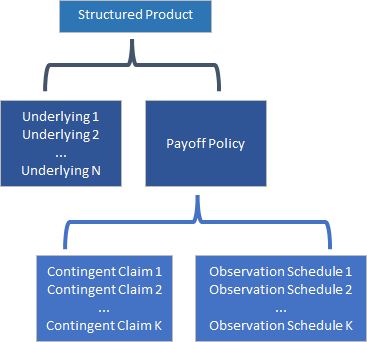
In more detail, a Structured Product consists of a Payoff Policy plus u underlyings U₁ , U₂ , ... , Uᵤ that can be a) securities such as stocks or b) indices such as equity indices or fx rates.
The Payoff Policy specifies the future times t₁ , t₂ , ... , tᵣ - referred to as observation times - when the market prices - or rates - of these underlyings are observed and affect the payment stream received by the note holder.
For example, the contract may reference two different stocks A and B, in which case u = 2.
Let t be one of the specified observation times.
At t, the observed market prices form the array of u real numbers x₁ , x₂ , ... , xᵤ.
In the two stocks example, the array would consist of the two share prices xA , xB observed at t.
The numbers x₁ , x₂ , ... , xᵤ are fed as input to one or more conditions that are technically represented by predicate functions defined in the Payoff Policy specified through the key Payoff Policy.
More precisely, the Payoff Policy contains one or more Contingent Claims, each of which contains its own predicate function 𝘨 specified through its key Trigger Fn.
In addition, each Contingent Claim also contains two functions ƒON and ƒOFF specified respectively through its keys On Pmt Fn and Off Pmt Fn.
Here is how it all works:
At any observation time t, the applicable Contingent Claims are examined, in a fashion that is explained in detail in Payoff Policy.
Then the condition - i.e. the predicate function 𝘨 - is evaluated and returns either TRUE or FALSE.
In the two stocks case, the condition could for example be that both xA and xB are above certain corresponding fixed levels, such as 110% of their initial reference values.
For example, let the initial reference values for the two stocks be 50 and 100 respectively, in which case the condition could be expressed by a predicate function that returns TRUE when the formula below holds:
xA > 55 and xB > 110
In the general setting, formally:
g(x₁ , x₂ , ... , xᵤ) = TRUE or FALSE
If the predicate function evaluates to TRUE, the event associated with the fullfillment of the corresponding condition is regarded as triggered with the effect that its associated function ƒON is calculated and the resulting amount amt is paid to the note holder in the specified denomination currency.
Formally:
amt = ƒON(x₁ , x₂ , ... , xᵤ)
The amount amt may correspond to a rebate that is paid only when the barrier is crossed by the share prices of both stocks.
Similarly, if the predicate function evaluates to FALSE, its associated function ƒOFF is calculated and the resulting amount amt is also paid to the note holder.
Look at the description of Payoff Policy for the details governing the applicability of the functions 𝘨 , ƒON and ƒOFF at any particular observation timet.