Scheduled Number Is Inside
Scheduled Number Is Inside is a direct subtype of Timed Real Trigger
aaaaaaaa aaaaaaaa aaaaaaaa aaaaaaaa aaaaaaaa aaaaaaaa aaaaaaaa aaaaaaaa aaaaaaaa aaaaaaaa aaaaaaaa aaaaaaaa aaaaaaaa aaaaaaaa aaaaaaaa aaaaaaaa
with functions Scheduled Number Is Inside Functions, keys Scheduled Number Is Inside keys and example object SchedNumInside
TYPE INCLUSION RELATIONSHIPS
AVAILABLE FUNCTIONS
AVAILABLE CREATE FUNCTION KEYS
TYPICAL OBJECTS OF TYPE Scheduled Number Is Inside
This type represents a predicate function ƒ that acts exactly like the more generic predicate function Scheduled Real Trigger, with the additional restriction that the predicate functions defined there through the key Triggers are here replaced by predicate functions of type Number Is Inside
Look at Scheduled Real Trigger for more details.
Another difference from Scheduled Real Trigger is that the predicate functions ƒ₁ , ƒ₂ , ... , ƒₙ corresponding to the applicable dates d₁ , d₂ , ... , dₙ are not defined explicitly, but generated implicitly by applying certain step up rules expressed as objects of type Step Up Rule
These rules are applied on the values associated with the key Interval of a given base predicate function ƒ₁
The predicate function ƒ₁ is specified throught the key Fn as an object of type Number Is Inside
In summary:
1The given schedule implies a sequence of dates d₁ , d₂ , ... , dₙ
2The given base predicate function ƒ₁ is of type Number Is Inside and characterized by certain parameter sets denoted as 𝒫₁
3The given step up rules imply the sequence of stepped-up parameter sets: 𝒫₁ , 𝒫₂ , ... , 𝒫ₙ
4The implied parameters sets 𝒫₁ , 𝒫₂ , ... , 𝒫ₙ lead to the corresponding implied predicate functions: ƒ₁ , ƒ₂ , ... , ƒₙ
5Therefore the dates d₁ , d₂ , ... , dₙ correspond to the predicate functions ƒ₁ , ƒ₂ , ... , ƒₙ
6The predicate function ƒ works by delegating to one of the predicate functions ƒ₁ , ƒ₂ , ... , ƒₙ in the sense that ƒ(dᵢ , x₁ , x₂ , ... , xᵤ) = ƒᵢ(x₁ , x₂ , ... , xᵤ)
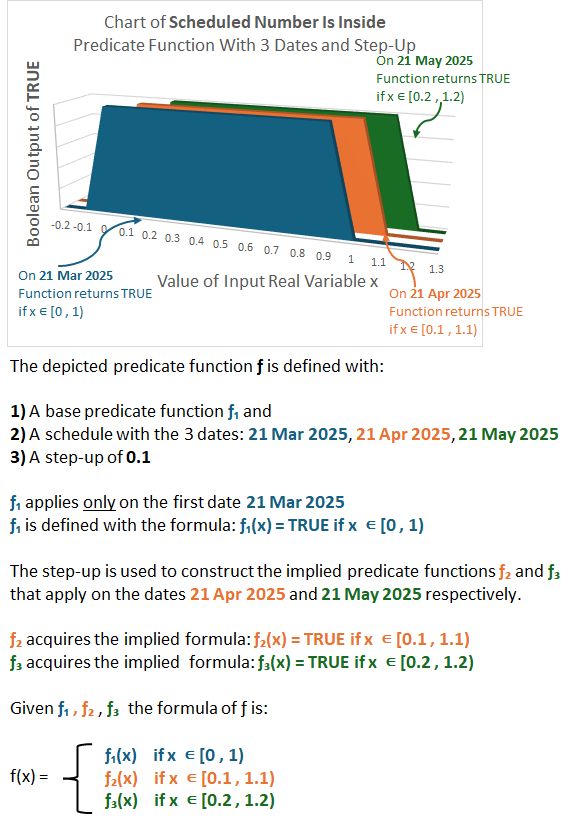
As an example, below is the chart of a Scheduled Number Is Inside predicate function that expects as input a date d followed by a real variable x and returns TRUE according to the following rules:
The depicted function's domain includes the 3 dates: 21-Mar-2025, 21-Apr-2025, 21-May-2025
The base Number Is Inside predicate funcion applies at the date 21-Mar-2025, returns TRUE if x ∊ [0 , 1) and corresponds to the blue line at the front.
The formulas for the two remaining predicate functions at the next dates of 21-Apr-2025 and 21-May-2025 are calculated from the given step up amounts of 0.1
It follows that the second predicate function as of 21-Apr-2025 returns TRUE if x ∊ [0.1 , 1.1) and corresponds to the orange line in the middle.
The third predicate function as of 21-May-2025 returns TRUE if x ∊ [0.2 , 1.2) and corresponds to the green line at the back.