
ELN Bonus Enhanced
ELN Bonus Enhanced is a direct subtype of ELN T1
aaaaaaaa aaaaaaaa aaaaaaaa aaaaaaaa aaaaaaaa aaaaaaaa aaaaaaaa aaaaaaaa aaaaaaaa aaaaaaaa aaaaaaaa aaaaaaaa aaaaaaaa aaaaaaaa aaaaaaaa aaaaaaaa
with functions ELN Bonus Enhanced Functions, direct subtypes ELN Bonus Enhanced subtypes, keys ELN Bonus Enhanced keys and example object ELN-BEN
TYPE INCLUSION RELATIONSHIPS
AVAILABLE FUNCTIONS
AVAILABLE CREATE FUNCTION KEYS
TYPICAL OBJECTS OF TYPE ELN Bonus Enhanced
This type represents what in Asian Markets is often known as "Bonus Enhanced Equity Linked Note".
In the U.S., similar payoff structures exist but under names like "Booster Note", "Enhanced Return Note", or more generally, under "Enhanced Participation" categories.
In Europe, equivalents appear as "Bonus Certificates" or generic structured notes with barrier/bonus features, depending on issuer and region.
A typical term sheet is the here.
Summary
Scroll below for the payoff charts.
The note's payoff amount is based on the performance of the worst performing underlying, referred below as the minimum performance.
It occurs only at maturity.
On the upside, the investor generally wins a fixed bonus, but receives only the principal if the minimum performance falls below a fixed level known as call barrier.
On the downside, the investor loses proportionally to the minimum performance if it falls below a certain level.
There exist two variants that affect the upside: The digital where the investor only wins the fixed bonus, and the non-digital where the investor participates in the minimum performance hike if the latter becomes more profitable than the fixed bonus.
There is also a knock-in barrier that is observed throughout the note's life with a given frequency.
A potential knock-in event during the life of the note only affects the level of the minimum performance below which the downside comes into effect.
If knocked in, that level is set to the knock-in strike.
If not knocked in, that level is set to the somewhat lower knock-in barrier.
Details
Underlying
The note references n stocks or stock indices S₁ , S₂ , ... , Sₙ with n ≥ 1, all of the same currency.
At any given observation time t in the future, these stocks (or stock indices) will have corresponding market prices S₁(t) , S₂(t) , ... , Sₙ(t).
The note also defines fixed so-called reference prices S⁰₁ , S⁰₂ , ... , S⁰ₙ
The payoff and the various triggers depend only on the performances P₁(t) , P₂(t) , ... , Pₙ(t) - also referred to as growth factors - defined as follows:
P₁(t) , P₂(t) , ... , Pₙ(t) = S₁(t)/S⁰₁ , S₂(t)/S⁰₂ , ... , Sₙ(t)/S⁰ₙ
Explicitly:
P₁(t) = S₁(t)/S⁰₁
P₂(t) = S₂(t)/S⁰₂
...
Pₙ(t) = Sₙ(t)/S⁰ₙ
From a quantitative perspective, the performances P₁(t) , P₂(t) , ... , Pₙ(t) may be regarded as the note's underlyings.
Coupon
This note does not pay a regular coupon.
Knock-Out
This note does not have a knock-out provision
Knock-In
A knock-in event may occur at any time t that is part of a predefined set of v knock-in observation dates Tᴷᴵ₁ , Tᴷᴵ₂ , ... , Tᴷᴵᵥ.
The dates Tᴷᴵ₁ , Tᴷᴵ₂ , ... , Tᴷᴵᵥ are typically set through the stipulation of a knock-in observation frequency, such as monthly.
The knock-in event depends on the minimum performance PMIN(t), defined as:
PMIN(t) = min(P₁(t) , P₂(t) , ... , Pₙ(t))
A knock-in event occurs if:
PMIN(t) ≤ BKI
where BKI is a fixed number - such as 80% - referred to as the knock-in barrier.
The occurrence, or non-occurrence, of a knock-in event affects the redemption payment at the note's maturity, as seen below.
Redemption
The redemption amount at maturity T depends on whether a knock-in event has been observed at or before T.
There exist therefore two scenarios:
Redemption if a knock-in event has occurred
Let P denote the performance at T of the worst performing asset.
Equivalently, define P as:
P = PMIN(T)
In this case the payoff diagram at T looks as below, where the horizontal axis spans the P and the vertical axis spans the payoff per unit notional.
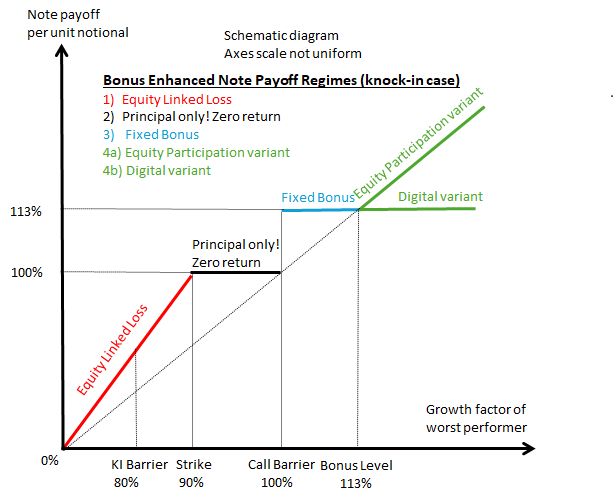
There exist 4 regimes depicted with different colors.
The fourth regime exhibits two variations, one where the investor participates in the equity upside and one where the investor receives a fixed digital payment.
The formulas for the various linear segments are as follows.
Equity Linked Loss segment (red line)
Payoff = (N/K)P if P < K
where N is the note's notional.
Note that in most term sheets this payoff is formulated differently - but equivalently - in terms of an allocation of shares to the investor, as described at info_#5
Example 1
N = 100 USD, K = 90%, P = 90%, then payoff = ((100 USD) / 90%) * 90% = 100 USD
Example 2
N = 100 USD, K = 90%, P = 85%, then payoff = ((100 USD) / 90%) * 85% = 94.44 USD
Principal Only, Zero Return segment (black line)
Payoff = N if K ≤ P < BCALL
where BCALL is a fixed number referred to as the call barrier
Fixed Bonus segment (blue line)
Payoff = B if BCALL ≤ P < B
where B is a fixed number referred to as the bonus level
The last segment comes in the following two variants.
Equity Participation variant (inclined green line)
Payoff = NP if B ≤ P
Example
N = 100 USD, B = 113%, P = 120%, then payoff = (100 USD) * 120% = 120 USD
Digital variant (flat green line)
Payoff = B if B ≤ P
Redemption if no knock-in event has occurred
In this case the payoff diagram at T looks as below.
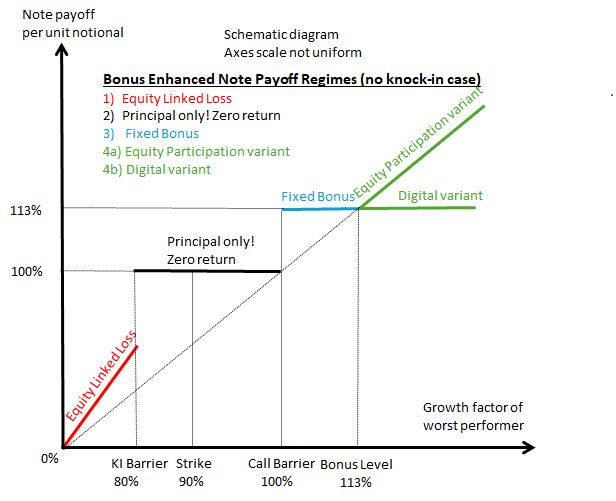
The only difference between this diagram and the previous one is that in the case here the Equity Linked Loss segment (red line) has shorter length.
It extends to the right only until the x-coordinate equals the knock-in barrier BKI
It is therefore obvious that the absence of a knock-in event is advantageous for the investor .
The applicable formula for that segment is:
Payoff = (N/K)P if P < BKI
Example
N = 100 USD, BKI = 80%, K = 90%, P = 70%, then payoff = ((100 USD) / 90%) * 70% = 77.77 USD
Payoff = N if BKI ≤ P < K
Example
N = 100 USD, BKI = 80%, K = 90%, P = 85%, then payoff = 100 USD, because P > BKI